REVIEW · MAHABALIPURAM
Mahabalipuram: Private Guided tour from Chennai with lunch
Book on GetYourGuide →Operated by 5 Senses Tours · Bookable on GetYourGuide
Stone carvings and blue-sky sea views.
This private day trip from Chennai is a focused hit of Mahabalipuram’s rock-cut wonders—especially the scale of Arjuna’s Penance—and I like that you get an English-speaking guide plus a proper hotel pickup and drop-off so the day runs on rails. The one thing to keep in mind: it’s a packed 7 hours with some walking, and at least one stop has more stairs than the rest.
You’ll ride out with a tourism-ministry approved operator (Five Senses Tours Private Limited), then spend the day among Pallava-era monuments built into granite and living rock. You also end with a cultural stop at the colorful ISKCON temple, which gives the day a different flavor after all those mythological bas-reliefs.
In This Review
- Key Highlights You’ll Actually Feel
- The Value in a Private Mahabalipuram Day Trip From Chennai
- Your Morning Start: Pickup, Ride Time, and Setting the Pace
- Pancha Rathas: Learn to Read the Stone at the Start
- Arjuna’s Penance: A 100-Foot Story Scene That Makes You Slow Down
- Krishna’s Butterball: The Gravity-Question Stop
- Ganesha Ratha and the Inscription Details People Miss
- Mahishasura Mardini Cave: Vishnu Dreaming, Durga Fighting
- Varaha Cave: Granite Scale and Guardian Figures
- Shore Temple: The Sea-Linked Finale and the Marco Polo Thread
- ISKCON Temple Stop: A Change of Pace After Myth Carvings
- Lunch in a Vegetarian Restaurant: Why It Works in the Middle of the Day
- What Makes the Guides Matter: The Human Detail
- A Heads-Up: The One Stop That Can Feel Like Shopping Time
- Who This Tour Best Fits (and Who Might Want Something Else)
- Should You Book This Mahabalipuram Tour With Lunch?
- FAQ
- What is the duration of the tour?
- How much does the Mahabalipuram private guided tour from Chennai cost?
- Is hotel pickup and drop-off included?
- Are entrance charges included?
- Is lunch included, and what type of food is it?
- Are drinks included in the tour price?
- Is the tour group private?
- What language is the live guide?
- Can I cancel for a full refund?
- Can I reserve and pay later?
Key Highlights You’ll Actually Feel
- Hotel pickup + private car: easier Chennai-to-Mahabalipuram logistics than self-planning
- Pancha Rathas first, then the giants: a smart order that builds your eye for the carvings
- Arjuna’s Penance at 100 by 45 feet: you’ll need time to take in the full storytelling panel
- Krishna’s Butterball: a “wait, how is that standing?” boulder moment
- Cave temples with Vishnu and Durga: two different myth worlds in one stop
- Shore Temple + Marco Polo connection: a seaside finale tied to famous historical travel writing
The Value in a Private Mahabalipuram Day Trip From Chennai
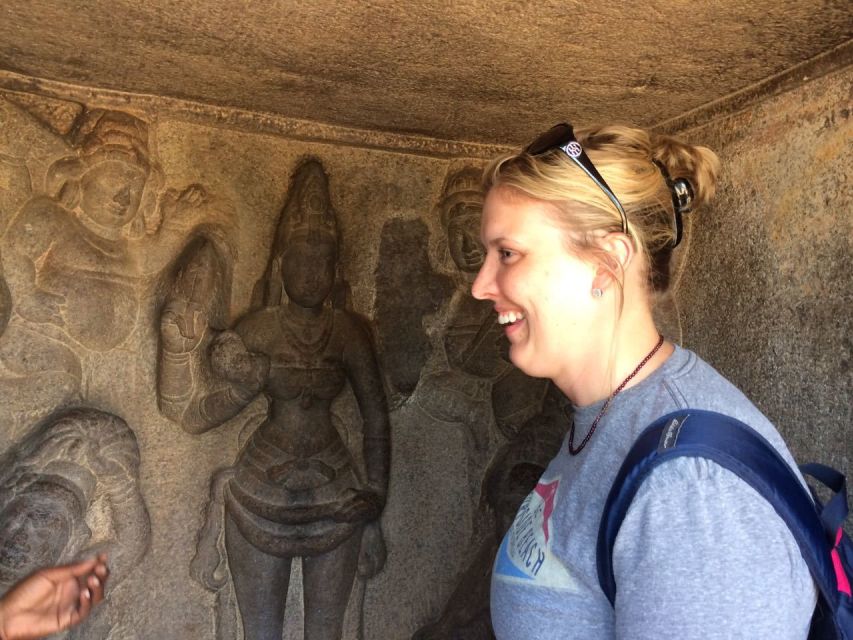
Mahabalipuram is one of those places where “a couple of temples” turns into a whole day fast. The big advantage of this tour is that it’s set up as a private experience with a live English guide, entrance charges handled, and a lunch stop included—so you can spend your energy looking, not sorting.
At $120 per person for 7 hours, it’s not a budget squeeze, but it also isn’t overpriced if you want convenience. You’re paying for a full, guided structure: hotel pickup/drop-off, private transport, monument entry, and lunch are bundled together. The drinks aren’t included, so factor that in if you’re someone who likes a soda or bottled water with your meals.
The best practical detail? The transport quality is heavily rated (97% of reviewers gave it a perfect score), and multiple guide-driver pairings were praised for working smoothly from the morning start.
You can also read our reviews of more guided tours in Mahabalipuram
Your Morning Start: Pickup, Ride Time, and Setting the Pace
This tour begins with pickup from your hotel lobby, then you’re in a private car with an English-speaking guide. That matters because Mahabalipuram is far enough from Chennai that arriving with a plan saves time and stress.
The drive also gives the guide a chance to warm you up with context: who built these monuments (the Pallavas), why Mahabalipuram mattered as a port, and what you’re about to see carved into rock. Even if you’re not a “history person,” it helps you notice things you’d otherwise miss—like repeated myth characters or the way scenes are organized.
Practical tip: wear comfortable shoes. You’ll be moving between multiple carved sites, and the pace is meant to fit them all into one day.
Pancha Rathas: Learn to Read the Stone at the Start
Your first big monument stop is Pancha Rathas, often called the 5 Chariots. These aren’t freestanding buildings in the usual sense. They’re rock-cut monolith structures—carved from stone as monolithic “chariots” tied to characters from the Mahabharata.
What makes this stop valuable is that it trains your eye. Before the huge bas-relief arrives, you learn the basic visual language: how columns, shapes, and icon-like details were carved to represent sacred ideas.
You’ll see rathas dedicated to the key Mahabharata figures: Draupadi, Arjuna, Nakul-Sahadeva, Bhima, and Yudhister. There’s also an elephant sculpture near the ratha of Nakul-Sahadeva. It’s the kind of small detail that’s easy to miss if you’re rushing—so having a guide here pays off.
Possible drawback: if you’re expecting one “main highlight” only, Pancha Rathas can feel like a prelude. But that’s actually the point. By the time you reach the larger works, you’ll recognize the style and storytelling more easily.
Arjuna’s Penance: A 100-Foot Story Scene That Makes You Slow Down
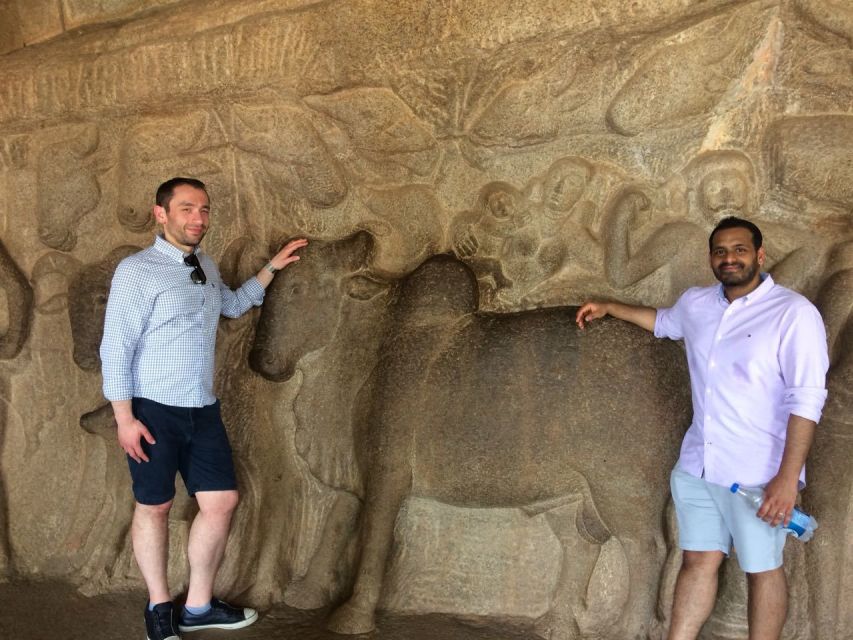
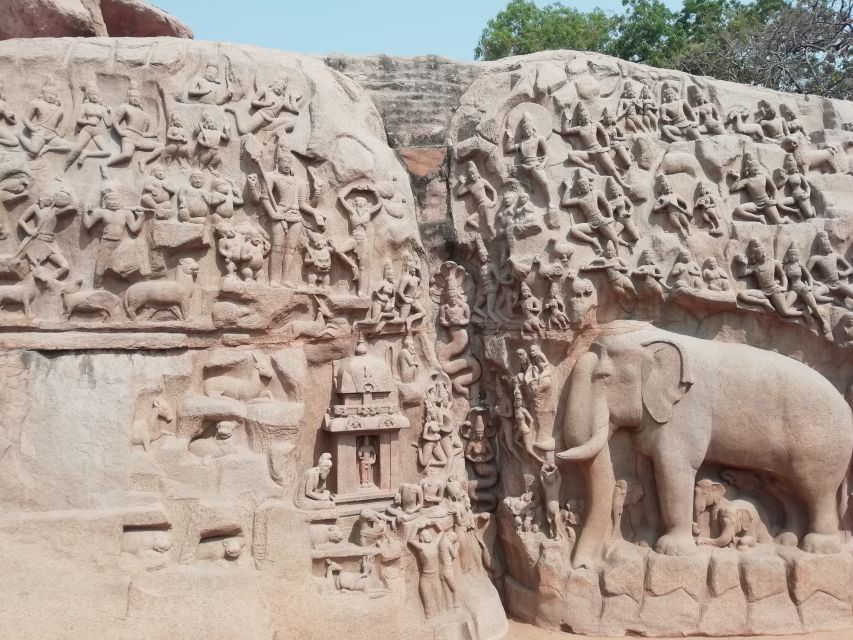
Next comes the big one: Arjuna’s Penance, a bas-relief panel about 100 feet by 45 feet. This is where the tour’s myth-and-monument theme turns cinematic. The central feature is the river Ganga, surrounded by divine beings, hunters, animals, birds, and trees connected to the Himalayan realm.
And then there are those memorable oddities that a guide will point out—because they’re funny, weird, and human. One example: a cat standing on one leg, posed like a holy man, while mice gather around. It’s playful symbolism inside an enormous sacred composition.
This stop is the reason many people book a guided day trip rather than a do-it-yourself taxi-and-tickets. At this scale, you don’t just want to look—you want someone to help you decode what you’re seeing.
What you’ll want from your timing: don’t treat it like a quick photo stop. Spend a bit of time reading the panel in sections. You’ll get more out of it that way.
Krishna’s Butterball: The Gravity-Question Stop
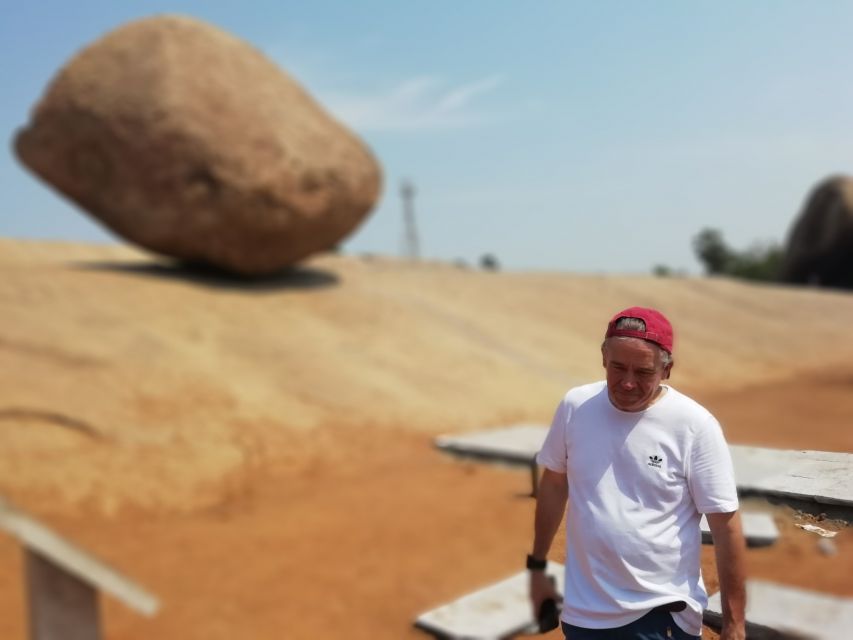
After Arjuna’s Penance, you visit Krishna’s Butterball—a ball-shaped boulder perched on a slope that looks like it shouldn’t hold. It’s about 5 meters in diameter, and the visual trick is part of the fun.
This is a shorter stop, but it’s a great reset. After hours of carved narrative, you get one moment that feels like a natural curiosity turned myth.
Tip for photos: step back, then re-frame close-up. It’s one of those stones where the angle makes or breaks the illusion.

Ganesha Ratha and the Inscription Details People Miss
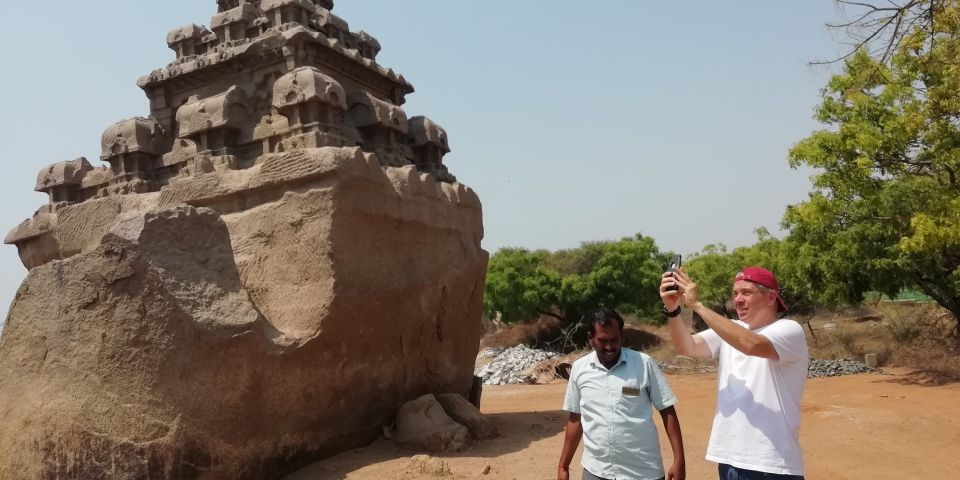
The tour continues to Ganesha Ratha, an imposing chariot carved out of a single stone. It was originally dedicated to Lord Shiva but later associated with Lord Ganesh—a common theme in temple evolution where older sacred spaces shift in emphasis over centuries.
One reason this stop keeps earning attention is that it includes 18 inscriptions in ancient scripts (Grantha and Nagari) of Sanskrit. If you care about details, this is your moment. You’ll see the site isn’t only visual; it also carries written layers that anchor it to its era.
If you’re more of a “show me the story” person, your guide can still connect these inscriptions to the broader Pallava-era culture and how knowledge was recorded.
Mahishasura Mardini Cave: Vishnu Dreaming, Durga Fighting
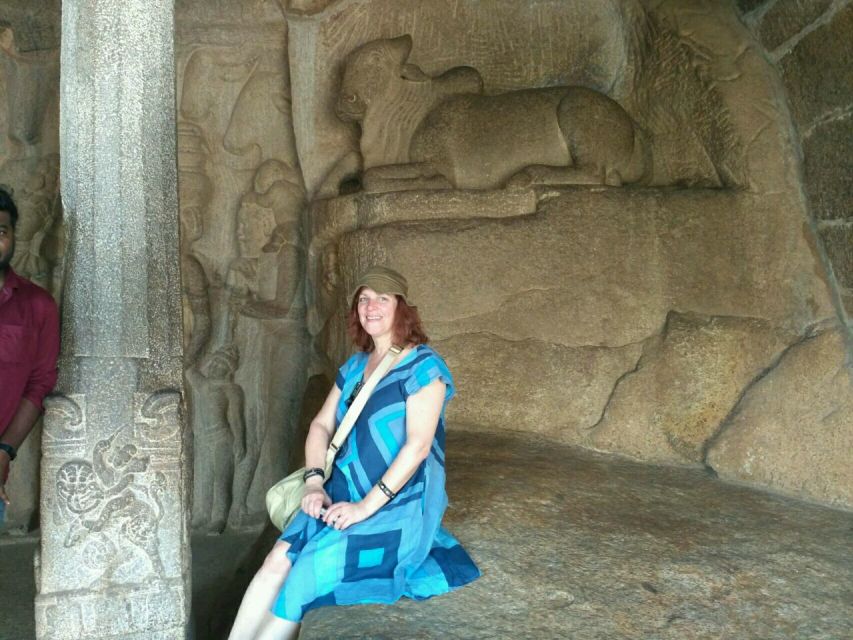
Two standout works share the cave experience at Mahishasura Mardini Cave.
- One relief shows Lord Vishnu sleeping on the coils of a serpent.
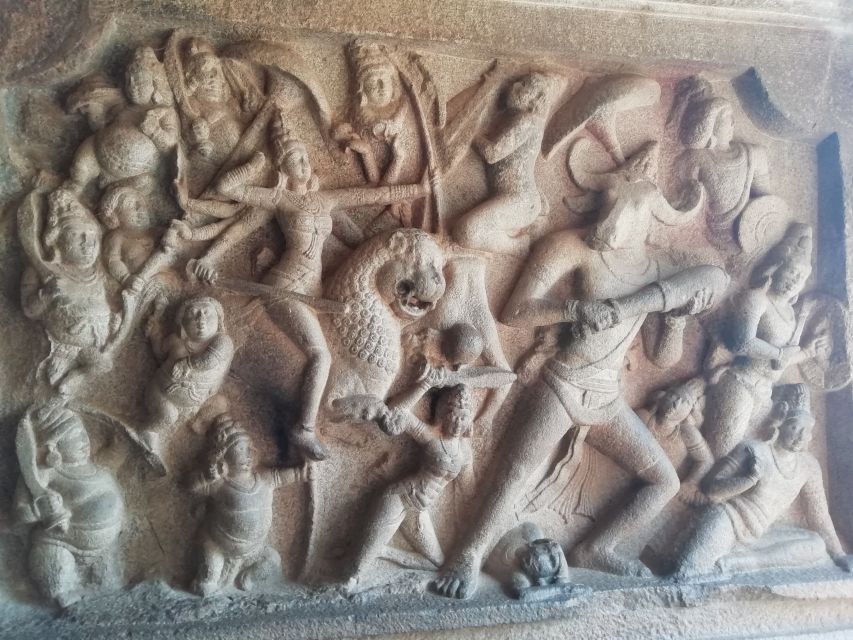
- The other depicts Goddess Durga fighting the demon, riding a lion.
This pairing matters because it gives you contrast: cosmic rest on one wall, fierce action on the next. It also helps you understand how these rock-cut sites used the architecture like a storybook.
Practical note: caves can feel cooler than the open air, but they can also mean uneven floors and tighter viewing angles. Go slow, especially if you’re traveling with older family members.
Varaha Cave: Granite Scale and Guardian Figures
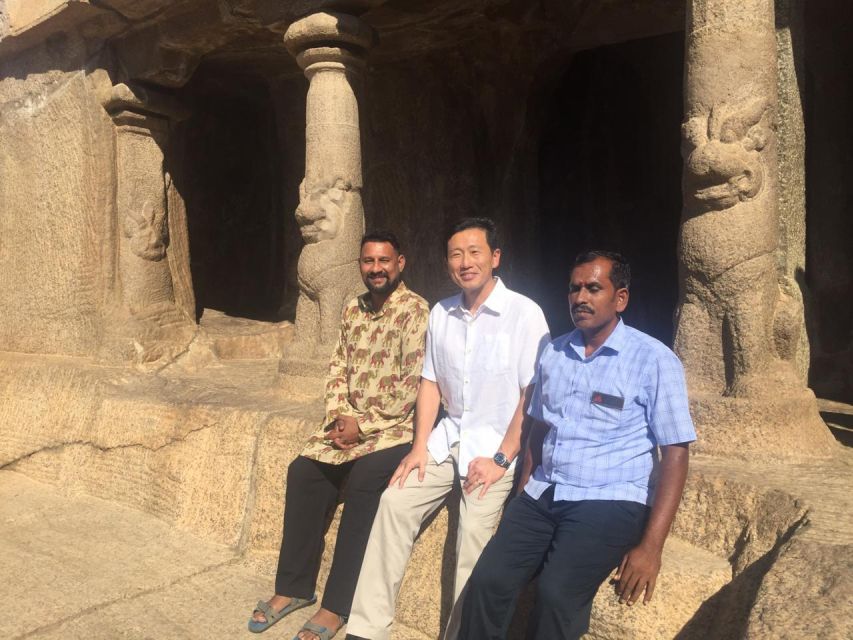
Then you move to the Varaha Cave, carved from a huge piece of granite and dating back to the 7th century. This is one of the places where you feel the time scale of the effort: it took decades to complete.
You’ll find squatting lions adorning pillars, plus two guardian angel-like figures protecting the sanctum. The whole hall works like a protective shell around the sacred core.
If you’re interested in how art communicates power, this is a strong stop. The guardians aren’t subtle, and the architecture supports that “serious place” feeling.
Shore Temple: The Sea-Linked Finale and the Marco Polo Thread
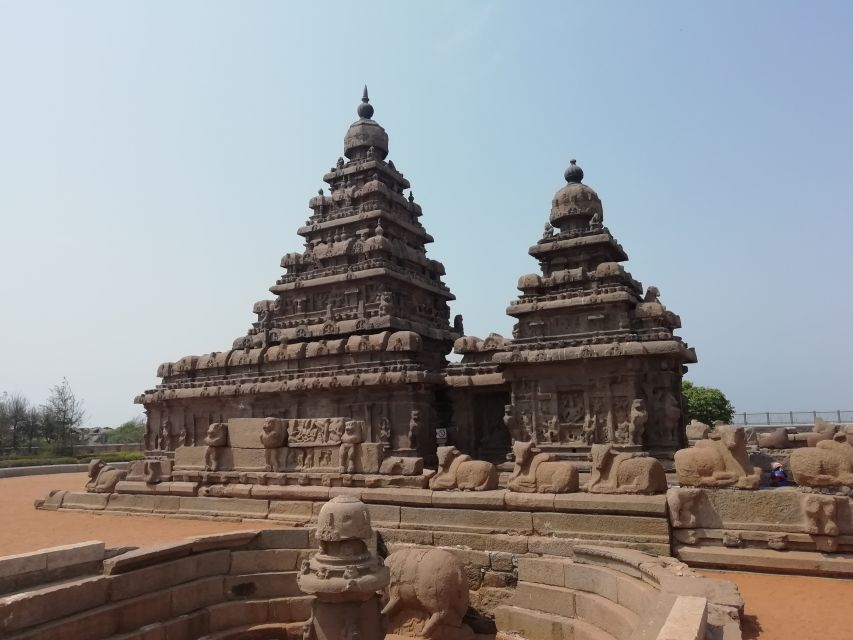
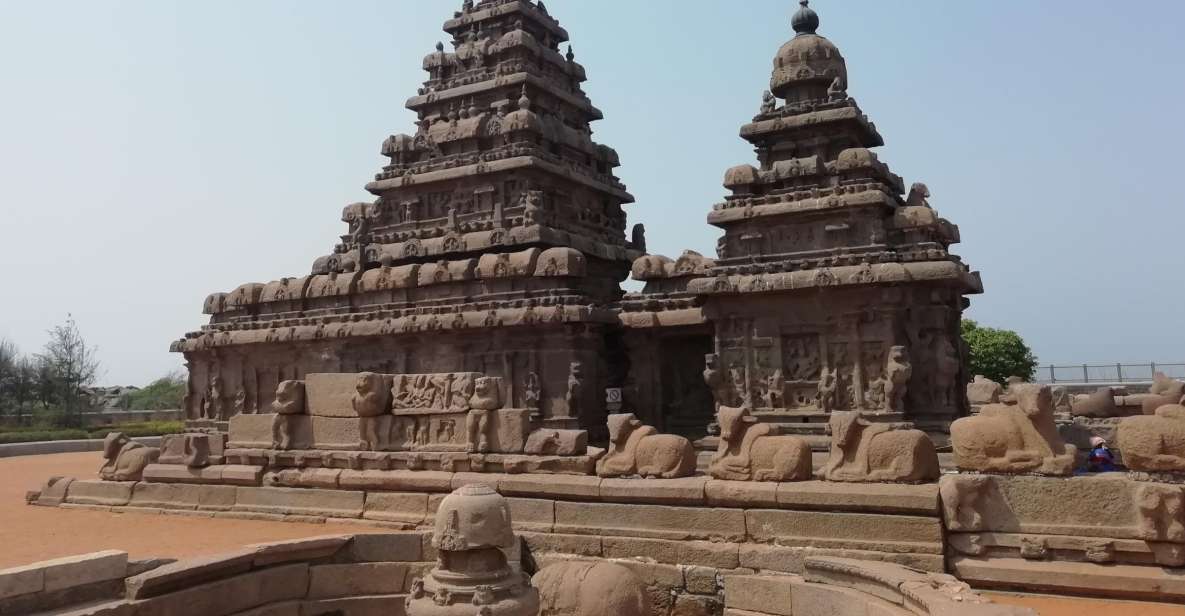
Your final monument big finish is the Shore Temple, an 8th-century structural temple made of granite. It was used as a beacon for sea farers, which turns the temple from “just a ruin” into an object with real-world navigation value.
There’s also a legend about a complex of seven temples along the sea. And here’s the famous name-drop: Marco Polo referenced Mahabalipuram in his memoirs and associated it with the city of the 7 pagodas during his travels.
After so many rock carvings, this feels different. It’s more architectural, more open, and more tied to the coastline. It’s a great place to wrap your head around the fact that Mahabalipuram wasn’t only a religious site—it was also a trading and travel landmark.
If the light is good: take a few minutes just watching the sea side instead of immediately photographing. It’s the quickest way to feel what the temple’s “beacon” role meant.
ISKCON Temple Stop: A Change of Pace After Myth Carvings
After the stone-heavy sequence, the tour adds a stop for cultural immersion at the ISKCON temple. This is not an archaeological stop. It’s a living worship space, and that shift is valuable.
For many people, the carvings blur together by midday. ISKCON gives you a new kind of meaning: songs, rituals, and a devotional atmosphere that doesn’t depend on interpretation the way the bas-reliefs do.
Tip: dress respectfully. Even in a short visit, you’ll feel more comfortable covering shoulders and keeping clothes practical for heat.
Lunch in a Vegetarian Restaurant: Why It Works in the Middle of the Day
Lunch is included, and it’s served at a vegetarian restaurant. In practice, this becomes more than food. It’s the time buffer that keeps the day enjoyable, not frantic.
Some guides also help you understand flavors during the meal, which can turn lunch into a mini cultural experience rather than just fueling up. Either way, you’ll be grateful you’re not hunting for a restaurant with a clock ticking.
Drinks aren’t included, so keep that in mind if you want bottled water or a cold drink.
What Makes the Guides Matter: The Human Detail
One of the biggest reasons this tour earns such high marks is the guide quality. Different English-speaking guides have been praised for punctuality, for sharing enough story to connect the monuments emotionally and intellectually, and for practical help like pointing out photo angles.
Names that came up in the guide experience include Ramesh, Ganesh, Kennan, Kannan, Narayanan, and Nivethitha. The pattern is consistent: the best days feel like you’re being taught how to look.
A Heads-Up: The One Stop That Can Feel Like Shopping Time
Not every moment feels purely “monument.” One rider mentioned an additional, somewhat obligatory stop at a sculpture place with student-made work that didn’t feel high quality.
That doesn’t mean every tour day includes that exact stop, but it does suggest a useful strategy: if you dislike shopping detours, ask your guide at the start of the day what the timing will look like and whether there’s any extra stop after monuments.
The good news: the monument sequence itself is the main event, and the tour is designed to keep those highlights in the center of your schedule.
Who This Tour Best Fits (and Who Might Want Something Else)
This is a great match if you want:
- a tight, guided way to see the main Mahabalipuram sites from Chennai
- myth-and-architecture context, not just photos
- hotel pickup and drop-off that removes planning friction
- lunch included so you can focus on the monuments
It may feel less ideal if you:
- want a slow, unstructured day with lots of free time
- hate any extra stops that aren’t strictly monuments
- have limited mobility, since there’s walking and at least one site with more stairs than the rest
Should You Book This Mahabalipuram Tour With Lunch?
If you’re short on time in Chennai and you want the best Mahabalipuram hits without the hassle, I’d book it. The combination of private car, English guide, entrance charges, and lunch adds up to real value—especially because the monuments are hard to “read” well without help.
My main decision check: if you’re the type who hates detours, ask about any extra sculpture or shop-style stop before you go. If that’s a dealbreaker, you can adjust your expectations or search for a strictly monument-focused variation.
For most people, though, this is the kind of day trip that leaves you tired in a good way—thinking about rock-cut stories, tracing tiny figures on giant panels, and closing the loop with the Shore Temple by the sea.
FAQ
What is the duration of the tour?
The tour duration is 7 hours.
How much does the Mahabalipuram private guided tour from Chennai cost?
The price is $120 per person.
Is hotel pickup and drop-off included?
Yes. Pickup and drop-off are included, with pickup from the lobby of your hotel.
Are entrance charges included?
Yes, entrance charges are included.
Is lunch included, and what type of food is it?
Lunch is included. It’s provided at a vegetarian restaurant.
Are drinks included in the tour price?
No. Drinks are not included.
Is the tour group private?
Yes. It’s a private group.
What language is the live guide?
The live tour guide is English.
Can I cancel for a full refund?
Free cancellation is available up to 24 hours in advance for a full refund.
Can I reserve and pay later?
Yes. You can reserve now and pay later.