REVIEW · PONDICHERRY
Mehendi Art Class in Pondicherry
Book on Viator →Operated by Sita Cultural Center · Bookable on Viator
Henna art turns your hands into a canvas. In Pondicherry, a 90-minute Mehendi lesson at Sita Cultural Centre explains why designs matter in Indian ceremonies and shows how patterns travel across the world.
I also love that you make your own paste from crushed powder and practice on paper first, so beginners can jump in. The main consideration is timing: you’ll leave with fresh paste on your hand and you should plan to let it set for at least an hour before you scrape the dry henna off.
In This Review
- Key things to know before you try Mehendi in Pondicherry
- Sita Cultural Centre in White Town: the easy start point
- The 90-minute lesson rhythm: what happens in the session
- What you learn about Mehendi in ceremonies and worldwide patterns
- From crushed powder to mehendi paste: a hands-on moment
- Paper practice to real hands: tracing skills that actually stick
- Your finished design: how long to wait and what to do next
- Instructor-led care and the small-group advantage
- Price and value: why $11.54 can be a smart spend
- Timing and logistics: plan your afternoon like a craft day
- Who this Mehendi class is best for (and who might skip)
- Should you book this Mehendi art class in Pondicherry?
- FAQ
- Where is the Mehendi art class meeting point in Pondicherry?
- What time does the class start?
- How long is the class?
- Who can join this Mehendi class?
- How many people are in a class?
- Do I need to bring my own henna or supplies?
- Can beginners join if I have never drawn Mehendi before?
- What do we do during the session?
- Is food and drinks included?
- Is hotel pickup and drop-off included?
- Is there free cancellation?
Key things to know before you try Mehendi in Pondicherry
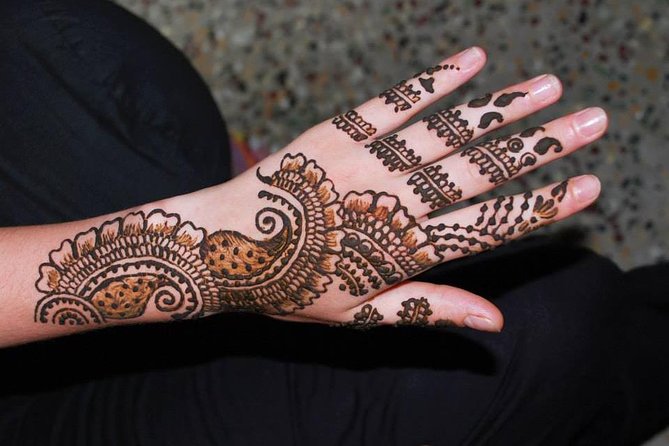
- Hands-on from the start: you’ll mix or learn how to make paste from crushed powder and then practice tracing designs.
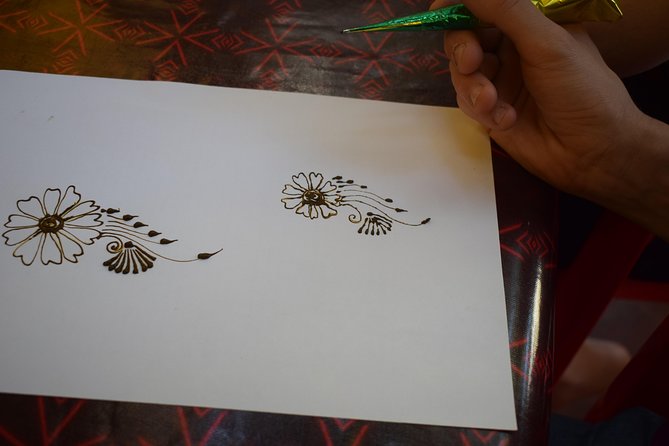
- Paper practice first: you start on a paper draft, then move to your own hand (or a friend’s).
- Meaning before marks: you get a guide-led talk on the purpose of Mehendi in ceremonies and how designs are drawn.
- Beginners welcome: the class builds from basic lines to more elaborate patterns.
- Small, flexible setting: the group stays small (max 6 people), and a booking can be up to 2 people.
- You’ll need patience after class: the paste needs time to set before you remove the dry layer.
Sita Cultural Centre in White Town: the easy start point
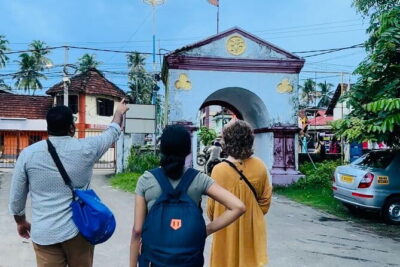
The class meets at Sita Cultural Centre, 22 Kandappa Mudaliar St, in White Town, Pondicherry. It’s an in-town location near public transportation, so you’re not stuck figuring out complicated logistics just to get to a craft class.
You’ll start at 3:00 pm, and the activity ends back at the same meeting point. That timing is handy if you want something cultural and hands-on without committing your whole day.
One practical thing: this is a family-friendly workshop with a minimum age of 8 years. If you’re traveling with kids, this can be a refreshing break from the usual walking, selfies, and shopping stops.
You can also read our reviews of more tours and experiences in Pondicherry

The 90-minute lesson rhythm: what happens in the session
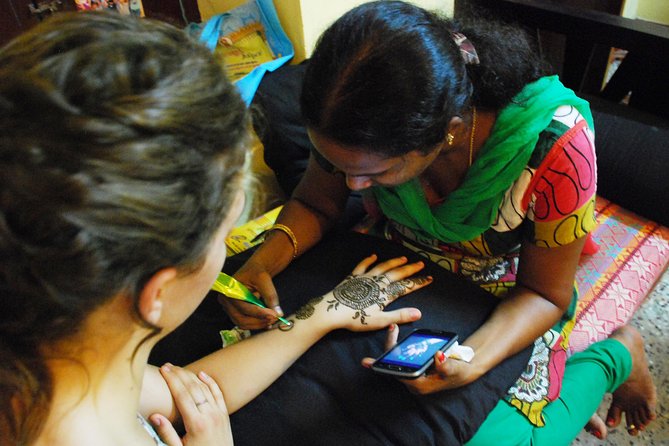
This isn’t a passive lecture where you just watch someone draw. The session has a clear flow that moves from explanation to practice to your own finished design.
The teacher starts with the story side. You’ll learn what Mehendi is used for in Indian ceremonies, and you’ll see examples of designs and patterns that are used beyond India too. Then you’ll get guidance on the way to draw: how lines form patterns and how you build up from simpler sections.
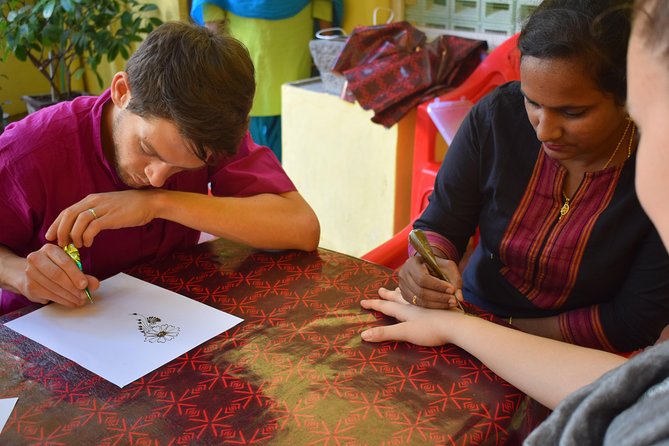
After that comes the practical part. You’ll try on a paper draft first, get comfortable tracing, and only then move toward drawing on a hand. The pace is designed so you can keep up even if you’ve never touched a henna cone before.
Finally, you leave with paste applied and a plan for how long to wait. That wait is part of the experience, not an afterthought. Henna is slow. That’s the deal.
What you learn about Mehendi in ceremonies and worldwide patterns
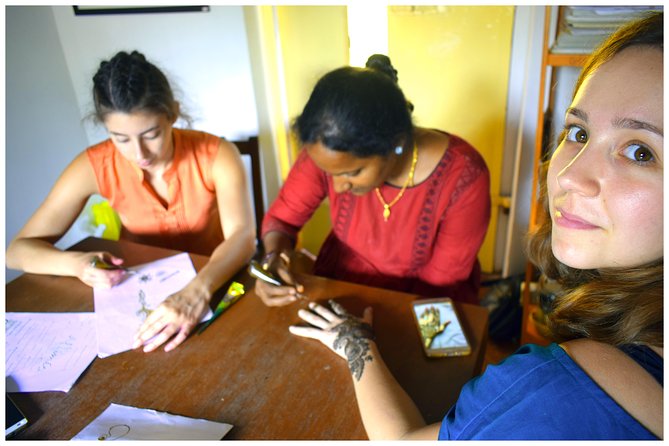
Before your hand ever becomes the canvas, you’ll get the meaning behind the marks. The teacher shares the purpose of Mehendi in Indian ceremonies and explains why it’s valued as part of special life moments.
You’ll also see different design examples and learn how the patterns relate to one another. One helpful takeaway is realizing that Mehendi isn’t one fixed look. It’s a whole family of motifs—lines, florals, geometric rhythms, and the ways artists combine them.
That context matters because it changes how you practice. Instead of copying a random doodle, you start thinking in patterns. You begin to understand how the design grows: where the main elements sit, how the smaller details fill the gaps, and how symmetry or balance plays a role.
If you’ve been collecting sights in Pondicherry—church facades, colonial streets, markets—this lesson adds a different layer: living tradition. You’re not just looking at culture; you’re making part of it.
From crushed powder to mehendi paste: a hands-on moment
A standout part of the class is that you get instruction in making your own Mehendi paste. The method described here is from crushed powder, not store-bought mystery stuff.
That’s great for two reasons. First, it helps you understand what you’re actually applying, so you can appreciate the skill behind clean lines. Second, it turns the class into something more than pattern copying. You learn the practical process, even if your first attempt isn’t perfect.
Paste consistency is key in henna work. When the texture is right, lines stay controlled. When it’s not, lines can wobble or thicken where you don’t want them. The class approach gives you a chance to learn with guidance rather than guessing on your own.
Also, because the session includes practice tracing, you’re not expected to become an expert in 90 minutes. You’re expected to start. That’s a very fair goal for beginners.
Paper practice to real hands: tracing skills that actually stick
You begin on a paper draft. That detail is a big deal. It lowers the pressure and lets you focus on line control—steady movement, consistent spacing, and how to keep your shapes from drifting.
Once you’re comfortable tracing, you move toward drawing on your own hand or the hand of a friend. The class is designed for both adults and kids, so the teacher can adapt the level of support.
The goal is progression. You start with simpler tracing and then work up toward more sophisticated patterns. It’s the same idea as learning letters before words. You build the muscle memory first, then you combine those strokes into something that looks like real Mehendi art.
One small note: the class may not be equally suited to everyone depending on how much you like careful handwork. If you hate slow crafts, henna might feel like waiting. But if you like steady attention and personalizing a design, this is a calm, satisfying hour-and-a-half.





Your finished design: how long to wait and what to do next
When the session ends, you’ll leave with a fresh henna design. The guidance given during class is that you should leave the henna paste for at least an hour before scraping off the dry layer.
That waiting time is the difference between a faint mark and a clearer stain. Even if you’re tempted to rush, don’t. Henna needs time to set and dry.
Also, plan for the practical side. Your hands will be sticky at first. Even when it dries, the paste can feel a bit stiff or crusty. Think of it as part of the craft, not a problem you need to solve right away.
If you’re going to dinner or an evening plan soon after, consider timing. A 3:00 pm class means your “at least an hour” window lines up nicely for an afternoon-to-early-evening schedule—use that to avoid stress.
Instructor-led care and the small-group advantage
The class runs with a teacher who explains as she goes, and the overall vibe is patient. One thing that really comes through in the teaching style is how willing the instructor is to answer questions and slow down if you need it.
There’s also a small-group feel. The session caps at 6 people, and the booking limit is up to 2 people per booking. That matters because Mehendi is a hands-on skill. When you’re not packed into a big crowd, you’re more likely to get corrections and guidance when your lines need a nudge.
I like that this isn’t treated like a production line. Even in a short class, you can still ask for clarification, and you can get help choosing how to place your design.
If you’re the type who likes crafts where someone actually watches what you’re doing, this setting will feel good.
Price and value: why $11.54 can be a smart spend
The price is $11.54 per person for about 1 hour 30 minutes. That’s low for a guided, hands-on workshop with a professional guide and instruction that includes making paste from crushed powder.
Here’s where the value comes from. You’re not paying just for a product you take home. You’re paying for:
- instruction that makes you more capable next time
- time to practice on paper first
- a guided path from basic tracing to more detailed patterns
- a fresh design on your hand at the end
Also, the class includes local taxes. That reduces the usual surprise fees you sometimes see with smaller experiences.
The main “cost” isn’t money. It’s attention and time while the paste sets. If you budget for that, the value feels very fair—especially for families or anyone who wants an authentic cultural activity without a huge ticket price.
Timing and logistics: plan your afternoon like a craft day
Start time is 3:00 pm, and you return to the meeting point afterward. That makes it easy to fit into an itinerary day.
Because there’s no hotel pickup or drop-off, you’ll want to reach White Town on your own. Good news: the meeting point is described as near public transportation.
You also won’t be provided food or drinks, so if you’re hungry, eat before you go. A henna class is slow enough that hunger can turn into impatience fast.
Finally, you’ll get a mobile ticket. That’s simple, but double-check you have it accessible offline or on your phone so you don’t have to hunt for signal while you’re standing in the right street.
Who this Mehendi class is best for (and who might skip)
This works well for:
- Families with kids age 8+
- Beginners who want a structured start (paper draft first)
- People who like hands-on cultural activities, not only sightseeing
It may feel less ideal if:
- You dislike crafts that require steady focus
- You can’t spare the “set time” after class (at least an hour before scraping)
- You want a quick photo-op only (this is skill-building, not just decoration)
If you’ve already ticked off the main sights in Pondicherry and you’re craving something more personal, this is a smart pivot. Instead of collecting objects, you leave with something on your skin—and the skill to make it again.
Should you book this Mehendi art class in Pondicherry?
Yes, if you want a calm, guided cultural activity that teaches real technique. The combination of ceremony context, paste-making instruction, and paper practice before hands-on drawing is a strong beginner-friendly package.
Book it especially if:
- you’re traveling with kids and want a family-friendly workshop
- you like learning through doing
- you want a unique Pondicherry memory that isn’t just another souvenir
One last practical check: plan your afternoon so you’re not rushing immediately after the class. Henna needs time to set, and the best results come when you give it that hour without stress.
If that sounds doable, you’ll get a lot from the small-group format, the instruction from the teacher, and the simple fact that you walk away able to draw patterns with more confidence than you had at 3:00 pm.
FAQ
Where is the Mehendi art class meeting point in Pondicherry?
The class meets at Sita Cultural Centre, 22 Kandappa Mudaliar St, White Town, Puducherry, 605001, India.
What time does the class start?
The start time is 3:00 pm.
How long is the class?
The duration is approximately 1 hour 30 minutes.
Who can join this Mehendi class?
The minimum age is 8 years, and most people can participate.
How many people are in a class?
The activity has a maximum of 6 travelers (people). Also, there is a maximum of 2 people per booking.
Do I need to bring my own henna or supplies?
The class includes instruction in making Mehendi paste from crushed powder and practicing designs, so you’re learning the process during the session.
Can beginners join if I have never drawn Mehendi before?
Yes. Beginners are welcome, and you start by practicing tracing designs.
What do we do during the session?
You learn the purpose of Mehendi in Indian ceremonies, view different designs and how to draw them, practice on a paper draft, and then draw on your own hand or a friend’s hand.
Is food and drinks included?
No. Food and drinks are not included.
Is hotel pickup and drop-off included?
No. Hotel pickup and drop-off are not included.
Is there free cancellation?
Yes, you can cancel for a full refund up to 24 hours before the experience’s start time.