REVIEW · CHENNAI
British Architecture Walk, an immersive walking tour in Chennai
Book on Viator →Operated by 5 Senses Walks · Bookable on Viator
Chennai wears its colonial clues on the street. This walk connects you to British-era design through British architecture landmarks you can actually see up close, not just read about. I like the small-group feel and the fact that you also get tea and snacks during the route. One heads-up: not every stop’s entrance is included, so a couple of buildings may ask for separate tickets.
What makes this one work well is the pacing and the guide. In the best cases, guides like Hareesh and Satish bring the buildings to life with practical, building-by-building context, and you’ll have time to ask questions instead of getting rushed. Optional hotel transfers can make the start and finish easier, especially if you’re not near the Marina/Chepauk area.
The whole experience runs about 2.5 hours and ends near the University of Madras. With a maximum of 15 people, it’s a relaxed evening walk that’s long enough to feel satisfying, but short enough you won’t feel like your legs are filing a complaint.
In This Review
- Key Things You’ll Notice on the Walk
- Why This British Architecture Walk Feels Like a Street-Level Museum
- Route Snapshot: Egmore to the University of Madras
- Egmore Railway Station: Henry Irwin’s Indo-Saracenic Statement
- Chennai Central: Gothic Revival Details and Robert Chisholm’s Touch
- Victoria Public Hall: Queen Victoria’s Golden Jubilee in Building Form
- Ripon Building and the Greater Chennai Corporation Office Area: Lord Ripon to G.S.T. Harris
- Southern Railway Headquarters and Indo-Saracenic Details: N. Grayson and Samynada Pillai
- Napier Bridge: Francis Napier, the Coovum River, and a Direct Link to Fort St George
- University of Madras Senate House: Robert Chisholm by the Marina Beach
- Victory War Memorial: From Cupid’s Bow to World War I Commemoration
- Guide Energy, Tea Breaks, and Why Small Groups Matter
- Price and Value: Is $55 Worth It in Chennai?
- Practical Tips So You Enjoy It More
- Should You Book This British Architecture Walk
- FAQ
- How long is the British Architecture Walk in Chennai?
- What is the price per person?
- What is included in the tour besides the guide?
- Is hotel pickup or drop-off available?
- How big is the group?
- Where does the tour start and end?
- Are admission tickets included for all stops?
- Does the tour use a mobile ticket?
- Is the meeting point near public transportation?
- What is the cancellation policy?
Key Things You’ll Notice on the Walk
- Indo-Saracenic and Gothic Revival in one route: you’ll spot British design labels showing up in Chennai’s own mix of styles
- Architects you can name: Henry Irwin, George Harding, Robert Chisholm, and more get linked to what you’re looking at
- Ticket coverage is partial: some key sites include admission, while a few other entrances may require extra payment
- Snacks plus coffee or tea: small comfort breaks built into the schedule
- Small group size (max 15): you get real back-and-forth with the guide
Why This British Architecture Walk Feels Like a Street-Level Museum
If you’ve ever wished you could understand Chennai’s architecture without bouncing between disconnected attractions, this tour is a smart fix. You follow a human scale route across major landmarks, and the guide helps you connect the dots between names, styles, and historical moments.
I especially like how it balances big-picture context with concrete details. Instead of only saying British influence shaped Chennai, you’ll see how specific buildings were designed, commissioned, expanded, and named. And because the group is small, questions don’t get lost in the shuffle.
The tone is also practical. You’re walking through real city spaces, so you get the feel of the neighborhoods around places like Egmore and the Marina, not just a postcard view from one angle.
You can also read our reviews of more walking tours in Chennai



Route Snapshot: Egmore to the University of Madras
The walk starts at Chennai Egmore, near Gandhi Irwin Rd (a convenient area if you’re already using public transport). It ends at the University of Madras area on Navalar Nagar, Chepauk/Triplicane.
Plan on a steady walking pace for about 2 hours 30 minutes. Most of your time at each stop is short, but it’s long enough to absorb what you see and hear why it matters. If you want to take photos, you’ll be able to do it, just don’t expect huge downtime at every site.
This route also works well because it layers functions: rail stations, civic halls, rail headquarters, bridges, university buildings, and a war memorial. That variety keeps the story from turning into one long lecture.
Egmore Railway Station: Henry Irwin’s Indo-Saracenic Statement
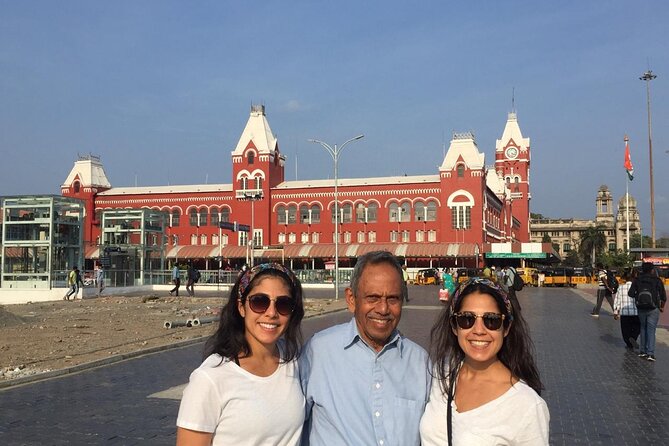
Egmore Railway Station is one of those buildings that looks instantly important, even before the guide starts explaining. You’re looking at an early example of Indo-Saracenic style, and the tour gives you the “who” behind the design.
The name Henry Irwin comes up here, and the scale is part of the story. The building was designed to be larger than London’s Charing Cross station, which helps you understand the ambition behind bringing British-era rail prestige to Chennai. In other words, this wasn’t just infrastructure. It was a statement piece.
Good to know: admission is included for this stop. That means less time worrying about tickets and more time focusing on details like the facade treatment and the way the building reads from multiple viewpoints.
One practical tip: stations are active places. Even on a guided walk, expect some local movement around you, so dress comfortably and be ready to step aside while people pass.
Chennai Central: Gothic Revival Details and Robert Chisholm’s Touch
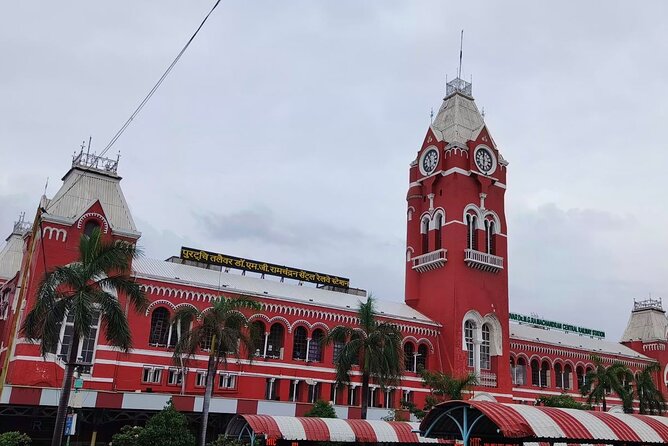
Next comes Chennai Central Railway Station, built in 1873 in Gothic Revival style. The tour credits architect George Harding for the original design, then explains how later changes shaped what you see today.
Robert Chisholm is the key name here. He modified the station and added the central clock tower and Travancore caps on the main structure. That combination is exactly what makes this stop valuable: you’re not just looking at an old building. You’re seeing evolution—how colonial-era design got adapted and layered over time.
Admission is included for this stop too, which is a plus if you prefer not to pay extra at each site. When you’re inside, your best bet is to focus on recognizable landmarks like the clock tower and the roofline details, since those are the features the tour ties directly to the architects.
Victoria Public Hall: Queen Victoria’s Golden Jubilee in Building Form
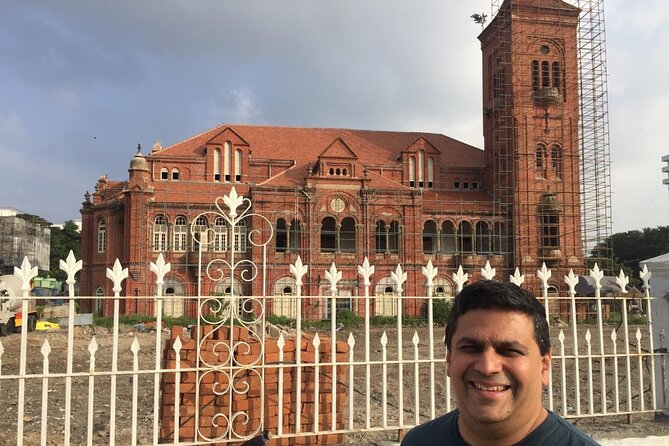
Victoria Public Hall is opened to the public in 1887 to commemorate Queen Victoria’s Golden Jubilee. You get the reason for the building’s existence, not just its appearance, which makes the facade and hall function feel less random.
The tour also notes how it was used over time for events and public meetings. That matters because civic buildings often carried the social “center of gravity” for colonial-era public life. In a city context, it’s part of how official space became cultural space.
Here’s the drawback to flag: admission is not included for this stop. If you want to go in, you may need to pay an entry fee at the site, depending on what’s open and what the schedule allows.


Ripon Building and the Greater Chennai Corporation Office Area: Lord Ripon to G.S.T. Harris
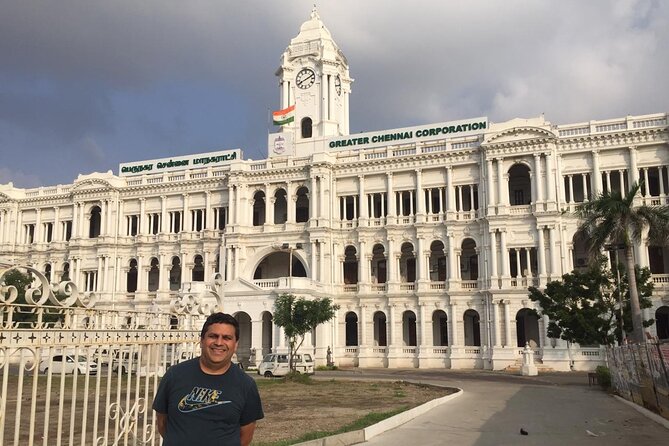
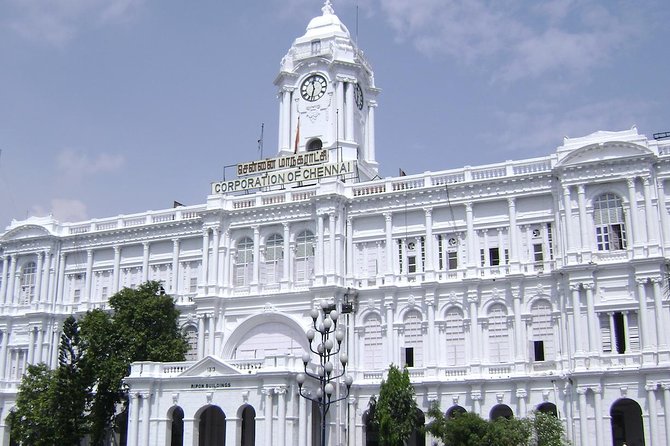
As the walk continues toward the Ripon Building (commissioned in 1913), you shift from stations and halls to something more administrative. The tour connects the name Ripon to Lord Ripon, a Governor-General, and then ties the design to specific people.
The building is described as designed by G.S.T. Harris and built by Loganatha Mudaliar. Getting names like that matters because it turns the architecture from a vague “colonial style” category into a human story: architects designed, builders constructed, patrons commissioned.
Admission is not included at this stop, so treat it as a strong exterior-view stop unless the site allows entry without a ticket. Even if you don’t go inside, the value is in spotting the building’s formal style and hearing how it fits the civic role.
If you’re the type who likes to compare facades, this is a good moment to pause and look for repeating patterns, symmetry, and how the building’s edges are framed.
Southern Railway Headquarters and Indo-Saracenic Details: N. Grayson and Samynada Pillai
The Southern Railway Headquarters is another Indo–Saracenic style structure, and the tour credits N. Grayson for the design and Samynada Pillai for building work. It was completed in 1921, so you’re looking at a later slice of the British-era building story compared to the older station landmarks.
This stop is a nice reminder that style wasn’t one-note. British-influenced architecture in Chennai often blended references, so you’ll see the “British label” while also seeing the local adaptation in materials, ornament, and the way the building holds its presence on the street.
Admission is not included for this stop. So plan on spending your time on the exterior and on what the guide points out. It’s still worth it—this is one of those moments where the explanation helps you notice what you’d otherwise gloss over.
Napier Bridge: Francis Napier, the Coovum River, and a Direct Link to Fort St George
Napier Bridge is one of the stops that makes the tour feel like more than architecture trivia. Built in 1869 across the Coovum River, it’s named after Francis Napier, the British governor of Fort St George. You connect a bridge to power and governance, which is a more interesting framing than just crossing a river.
The bridge’s role is practical too. It connects the Marina to Fort St George, so as you walk and look, you’re understanding how people moved between major city zones during the colonial period.
Admission is included for this stop, which makes it a smoother experience if you like a “tickets included” moment. The guide’s explanation also helps you understand the bridge’s form and how it was described, including that it’s a narrower bridge compared to what modern travelers might expect.
A good travel move here: take a few minutes to look both directions. Bridges are easy to photograph, but it’s the surroundings that help you understand why this connection mattered.
University of Madras Senate House: Robert Chisholm by the Marina Beach
As you head toward the University of Madras area, the tone shifts slightly from buildings tied to rail and governance into education. The key structure is the Senate House, described as the administrative center of the University of Madras.
Robert Chisholm appears again as the constructor, and the tour labels the building as a strong example of Indo-Saracenic style. That repetition is useful. Once you’ve learned what to look for in earlier stops, you start seeing the design language carry through into another major institution.
Admission is not included for this stop, so expect your experience to rely on what you can view without paying separate entry. Still, the value is in the explanation and the building’s relationship to its coastal context along the Marina Beach.
Victory War Memorial: From Cupid’s Bow to World War I Commemoration
The tour ends with the Victory War Memorial, which was formerly called Cupid’s bow. The guide ties it to the Allied victory in World War I, commemorating the 1914–1918 period, and then explains how it became known as the Victory War Memorial.
This stop adds an emotional layer that architecture walks sometimes skip. It’s not just bricks and design choices. It’s about memory carved into a visible city object. And once you hear the Cupid’s bow connection, you’ll likely start thinking differently about how city landmarks can change meaning over time.
Admission is included for this stop. That’s great if you want the final site to feel complete without extra costs.
If you’re into photography, this is a solid wrap-up: monuments often look best with a little space around them, and the guide’s framing helps you spot the details that make the memorial distinct.
Guide Energy, Tea Breaks, and Why Small Groups Matter
The tour is led by a local guide, and the whole experience benefits from that. In particular, I like that the guide can connect the building names to the real shapes in front of you.
The reviews in the world of this tour often highlight guide enthusiasm and strong storytelling. Names like Hareesh and Satish come up, and the common thread is clear: the guides focus on turning architecture into something you can understand quickly without feeling overwhelmed.
You’ll also get coffee and/or tea included, plus snacks at no extra cost. That matters more than it sounds. A 2.5-hour walk can feel long if you’re hungry, and having food and a drink built in helps you keep paying attention instead of checking your watch.
And if you need an easy win on comfort, optional hotel transfers are available. That can reduce friction on arrival and departure, especially if you’re staying away from the Egmore or Chepauk area.
Price and Value: Is $55 Worth It in Chennai?
At $55 per person, this is positioned as a mid-range guided experience. The value comes from three things:
First, you get a local guide and a small group size (maximum 15). That’s typically where your money becomes “understanding,” not just transportation.
Second, some admissions are included. Egmore Railway Station, Chennai Central Railway Station, Napier Bridge, and the Victory War Memorial have admission ticket included in the tour. Even if you don’t visit every building interior, those included tickets help your total cost feel more predictable.
Third, you get refreshments. Coffee/tea and snacks at no extra cost mean you’re not planning meals around the tour schedule.
The only real value risk is what’s not included: at a few stops, admission is not listed as included. If you plan to go inside every site, you might want to budget for extra entry fees where applicable.
If you want a focused architecture experience without spending hours figuring out tickets and routes yourself, I’d say this price is reasonable.
Practical Tips So You Enjoy It More
A few small things will make your walk smoother.
- Wear shoes you can walk in for 2.5 hours. This is a street and station mix, not a museum floor.
- If you care about interior access, ask the guide during the first portion of the walk which stops require separate tickets.
- Bring a phone for photos and notes. The guide is naming multiple architects, and it’s easier to remember when you can glance at your pics later.
- Plan to arrive a few minutes early for the Egmore meeting point near Gandhi Irwin Rd.
Also, since the tour is near public transportation, you can build it into a broader day plan easily.
Should You Book This British Architecture Walk
Book it if you want a guided, architect-focused way to see central Chennai in a short amount of time. It’s especially good for first-timers who like structure and context, and for anyone who appreciates design details but doesn’t want to do the research legwork on their own.
Skip it (or pick a different option) if you mainly care about modern Chennai or you hate paying extra at sites where admission isn’t included. Also, if you’re looking for lots of long indoor time, this walk is built for short stops and street-level viewing.
For most people interested in history through buildings, this is a smart, efficient, and genuinely enjoyable way to connect the city’s architecture to the people and periods that shaped it.
FAQ
How long is the British Architecture Walk in Chennai?
It runs for about 2 hours 30 minutes.
What is the price per person?
The price is $55.00 per person.
What is included in the tour besides the guide?
Coffee and/or tea and snacks are included, and the tour includes taxes, fees, and handling charges. It also includes a local guide.
Is hotel pickup or drop-off available?
Hotel pickup and drop-off are optional, depending on whether you select that option.
How big is the group?
The maximum group size is 15 travelers.
Where does the tour start and end?
It starts at Chennai Egmore (Gandhi Irwin Rd area) and ends at the University of Madras (Navalar Nagar, Chepauk/Triplicane).
Are admission tickets included for all stops?
Admission is included for some stops, and not included for others. For example, Egmore Railway Station, Chennai Central Railway Station, Napier Bridge, and the Victory War Memorial are listed with admission included, while stops like Victoria Public Hall and University of Madras are listed as admission not included.
Does the tour use a mobile ticket?
Yes, the tour includes a mobile ticket.
Is the meeting point near public transportation?
Yes, it is near public transportation.
What is the cancellation policy?
You can cancel for a full refund up to 24 hours in advance.