REVIEW · CHENNAI
Mahabalipuram walking tour by tourism ministry approved company
Book on Viator →Operated by 5 Senses Walks · Bookable on Viator
Mahabalipuram is history you can touch. This 3-hour walking tour in Chennai’s orbit focuses on the Pallavas and the UNESCO World Heritage monuments, with small groups capped at 15 so the guide can actually answer your questions. You’ll get a clear story of why these 7th-century stone temples and carvings matter, without feeling rushed into a museum-style checklist.
I like two things most. First, the route covers major sites such as Pancha Rathas, Arjuna’s Penance, and Shore Temple in one compact morning/afternoon block, and the guide keeps the explanations practical and easy to follow. Second, admission tickets are included at each stop, so the $50 price feels more like “guided access” than “basic sightseeing.” One possible drawback: the time is tight, so if you prefer slow wandering or lots of photos in every doorway, you may wish you had an extra hour.
If your guide is Ramesh, you’re in for particularly strong storytelling, and some groups even note he’ll adjust the pacing when there’s time. Still, expect a real walk across uneven stone—great for most people, but not a great match if you want a fully flat, low-effort stroll.
In This Review
- Key takeaways before you go
- Why Mahabalipuram feels different from a quick Chennai stop
- The small-group setup (max 15) and why it matters
- Shore Temple start, Five Rathas finish: how the route works
- Your 3-hour walk: what you’ll see at each stop
- Pancha Rathas: the rock-cut “chariots”
- Pancha Pandava Cave: pillars, pilasters, and yali creatures
- Arjuna’s Penance: a bas-relief you can measure with your eyes
- Krishna’s Butter Ball: the rock that looks like it shouldn’t be there
- Varaha Cave Temple: 7th-century stone craftsmanship
- Trimurti Cave: Brahma, Vishnu, Shiva in Pallava form
- Ganesh Ratha Temple: one stone, heavy presence
- Old Light House: the port-era surprise
- Mahishasura Mardini Cave: Vishnu resting and Durga fighting
- Shore Temple: the final monument with the Bay of Bengal behind it
- Transport choice: walking vs autorickshaw (and buggy rides if needed)
- Price and value: $50 that includes entry tickets
- Comfort, pacing, and weather sense
- Who should book this Mahabalipuram walking tour
- Should you book? My straight answer
- FAQ
- How long is the Mahabalipuram walking tour?
- Where does the tour start and end?
- What’s the price per person?
- How many people are in the group?
- Are admission tickets included?
- Do I need to print anything, or is there a mobile ticket?
- Can I choose to walk or take an autorickshaw?
- What’s the weather rule?
- What is the cancellation policy?
Key takeaways before you go
- Small group (max 15) means you’re not lost in the crowd and the guide can keep an eye on the group.
- Admission tickets included at each stop removes a big hassle and helps justify the $50 cost.
- Pancha Rathas to Shore Temple covers the most important Pallava monuments in about 3 hours.
- Walk or autorickshaw option gives you control if your feet need a break.
- Old Light House (built 640) adds a rare port-era angle, not just temple sightseeing.
- End point at Five Rathas helps you picture the site as a whole, rather than backtracking endlessly.
Why Mahabalipuram feels different from a quick Chennai stop
Mahabalipuram isn’t just another temple town. It’s one of Tamil Nadu’s clearest windows into the Pallavas, a dynasty that left behind rock-cut temples and carved monuments that still look startlingly precise today.
What helps on a guided walk like this is that you don’t have to guess what you’re looking at. For example, Arjuna’s Penance is famous for its long bas-relief scenes from the Mahabharata, but the real payoff is when someone connects those carvings to the bigger Pallava story: who built, why they built, and how this art fits into a living religious and cultural landscape. Same idea at the caves—these aren’t random holes in rock. They’re built spaces with careful support pillars, sculptures, and themes repeated across different sites.
There’s also the coastal context. You’re dealing with a place that was a working port by the 7th century, and the tour includes Old Light House, built in 640. That single stop shifts your thinking from “temple complex” to “maritime world,” which makes the monuments feel more grounded in real history.
You can also read our reviews of more walking tours in Chennai



The small-group setup (max 15) and why it matters
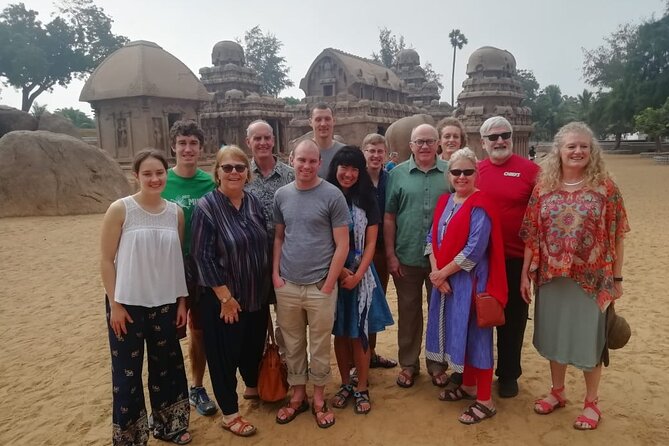
A group capped at 15 might sound like a marketing detail, but it changes how the walk feels. In a big group, you usually spend half your time trying to catch up or crane your neck. Here, the pace is easier to manage, and the guide can keep things clear without repeating the same points for everyone every two minutes.
The best part is attention. The tour is designed for history and architecture buffs, yet it doesn’t require you to know terms in advance. When the group is small, you can ask quick questions—like what a specific carving represents or why a structure is shaped the way it is—and still stay on schedule.
From the reviews, one theme pops up: the guiding style is enthusiastic and flexible. Ramesh is specifically mentioned as knowledgeable and pleasant, and there’s even a note that he extended the tour by another hour for extra time. I can’t promise that schedule change on every departure, but it does suggest the guide isn’t reading a script on autopilot.
Shore Temple start, Five Rathas finish: how the route works
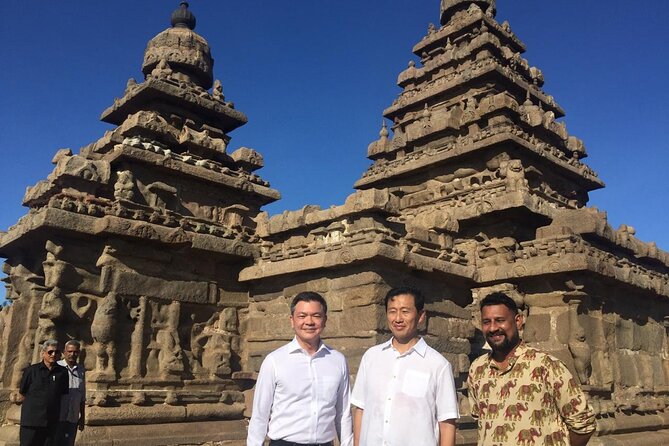
The meet-up is near Mahabalipuram Shore Temple on Beach Rd, in the Mahabalipuram area. The walk ends at the Five Rathas (Pancha Rathas) area, so you don’t finish by returning to the same starting point.
That matters because it affects your day logistics. If you’re combining this with other time on your own—beach time, a quick café stop, or more temple wandering—ending at Five Rathas is convenient. It also helps you mentally link the early and late parts of the story: you’ll keep noticing architectural similarities as you move through the site.
One more practical note: the tour is described as near public transportation. That’s useful when you’re planning your arrival and departure without relying entirely on a private ride.
Your 3-hour walk: what you’ll see at each stop
This is a compact route, with stops that last roughly 15–20 minutes each. That’s long enough to understand what you’re looking at, and short enough to keep energy high.
Pancha Rathas: the rock-cut “chariots”
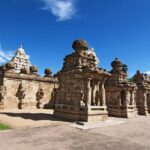
You start at Pancha Rathas, the five rock-cut monolith structures. Think of them as stone architecture that looks like temple chariots—each dedicated to a lead figure, with different forms carved into massive blocks.
The value of this opening stop is that it sets the visual vocabulary for everything else. Once you’ve seen how the Pallavas shaped stone into temple-like forms, the next caves and reliefs don’t feel random. They feel like variations on the same artistic language.

Pancha Pandava Cave: pillars, pilasters, and yali creatures
Next is the Pancha Pandava Cave. It’s the largest cave-temple at Mahabalipuram, supported by six pillars and two pilasters. The big visual hook here is the trio of sculptures called Yali on the pillars—mythical creatures placed where you can’t easily miss them.
If you’re into symbolism, this stop is satisfying because the carvings aren’t just decorative. They act as identifiers, guiding you toward the cave’s myth and theme.
Arjuna’s Penance: a bas-relief you can measure with your eyes
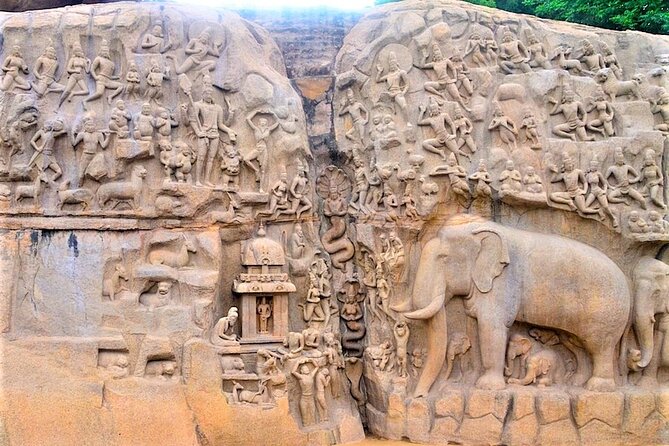
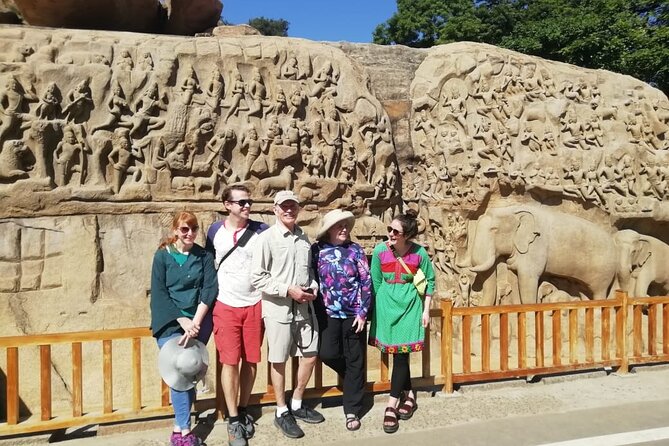
Arjuna’s Penance is the long one—about 100 feet long and 45 feet tall—covering vivid Mahabharata scenes in bas-relief form.
This stop is one of the reasons the tour works for architecture-minded visitors. A guided walk helps you shift from “wow, it’s big” to “wow, it’s organized.” You’ll learn how the figures are laid out and why this relief is considered one of the most magnificent ancient art pieces in India.
Photo tip: choose a spot that lets you see the scale. If you stand too close, it’s hard to understand the full composition.
Krishna’s Butter Ball: the rock that looks like it shouldn’t be there
Then you reach Krishna’s Butter Ball, a granite boulder poised on a stony slope. It’s famous because it seems to defy gravity and hasn’t moved despite its precarious position.
Here’s the practical angle: the tour guide’s explanation is helpful because this is one of those sites people rush past without understanding why it became a talking point. You’ll get the story and the visual cues—what to look for in the shape and how the boulder’s placement fits into the larger stonework environment.
Varaha Cave Temple: 7th-century stone craftsmanship
The Varaha Cave Temple is carved from a huge granite piece and dates back to the 7th century. This temple took several decades to complete, which hints at the scale of labor behind the scenes you’re walking through now.
You’ll notice squatting lions adorning the pillars that support parts of the structure. That kind of detail is exactly where a guided visit earns its keep: you’re not just seeing a cave temple; you’re seeing how the entrance and support elements were staged to communicate power and protection.
Trimurti Cave: Brahma, Vishnu, Shiva in Pallava form
The Trimurti Cave is a classic Pallava style rock-cut temple dedicated to the Hindu holy trinity: Brahma, Vishnu, and Shiva. The carvings include elephants, adding another layer of animal symbolism and visual rhythm.
This stop is ideal if you like comparing themes. Notice how the cave’s purpose shapes what you see. The guide helps you connect the dedication to the design choices, which makes the carvings feel purposeful instead of ornamental.
Ganesh Ratha Temple: one stone, heavy presence
Ganesh Ratha Temple is an imposing chariot carved out of a single stone. It was originally dedicated to Lord Shiva, but later the deity shifted to Lord Ganesh.
Built in the 7th century by King Mahendravarman I, it’s the kind of fact that makes you slow down. Not because you need a textbook, but because knowing who built what changes how you interpret the monument. You’ll start spotting patterns that match the era and the dynasty’s style.
Old Light House: the port-era surprise
Old Light House is a standout because it isn’t purely temple architecture. Built in 640, it’s described as India’s oldest lighthouse and one of the oldest in the world.
Mahabalipuram being a busy port since the 7th century explains why this matters. The lighthouse connects the site to movement, trade routes, and the practical problem of keeping mariners safe—far from the quiet vibe people expect from a temple town.
If you’re the type who likes “why is this here” more than “what is this,” don’t skip the questions during this stop.
Mahishasura Mardini Cave: Vishnu resting and Durga fighting
This cave includes two major bas-reliefs. One shows Lord Vishnu sleeping on top of the coils of a serpent. The other depicts Goddess Durga fighting with the demon Mahishasura on a lion.
This is a strong storytelling pairing: rest and motion, cosmic order and dramatic struggle. The guide’s role is huge here because it’s easy to recognize the figures and still miss the bigger meaning. In a short stop, you want a guide who can explain the scene without turning it into a lecture—and the descriptions here suggest that’s how the tour runs.
Shore Temple: the final monument with the Bay of Bengal behind it
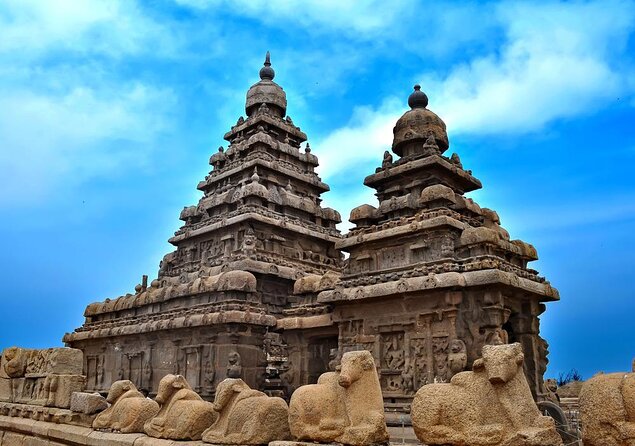
The tour ends with Shore Temple, overlooking the Bay of Bengal. It’s described as an important Pallava-era center when Mahabalipuram served as their main port.
This is where you appreciate the coastal placement. When you connect the lighthouse and the port context with the temple’s location, the whole site starts to make more sense as a single system: seafaring needs, trade activity, and religious power all tied together.
Transport choice: walking vs autorickshaw (and buggy rides if needed)
You get a choice: explore on foot or use an autorickshaw. That flexibility is not just for comfort—it helps you keep the tour enjoyable.
If you’re traveling with older family members or anyone with foot issues, don’t assume you’ll have to push through every stretch. One review specifically mentions buggy rides for seniors, which hints that the operator may offer a lighter option when needed. Since your tour’s exact vehicles can vary, ask your guide on the day what’s easiest for your group.
My advice: decide based on energy, not pride. A monument tour works best when you’re present and can look closely, not when you’re counting minutes to the next bench.
Price and value: $50 that includes entry tickets
At $50 per person for about 3 hours, the price is best understood as a bundle of three things: guided interpretation, small-group access, and included admissions.
Admission tickets are included at the stops, which is a big deal. When you pay separately for entries at multiple monuments, the total cost rises quickly. Here, you’re paying for one structured experience that helps you see and understand far more than you’d likely do on your own in the same time.
You may also get group discounts, and the tour includes a mobile ticket. If you’re the kind of traveler who hates fumbling with paperwork, that’s a small but real quality-of-life win.
One more value point: capping at 15 travelers helps keep the guide time effective. In other words, you’re not just buying a map—you’re buying human guidance.
Comfort, pacing, and weather sense
The tour requires good weather. That doesn’t mean you need perfect conditions, but it does mean cloudy skies or rain could affect what happens. If weather is uncertain, plan your day so you’re not trapped with only one fixed time block.
Comfort-wise, you’ll be outside and moving between stone monuments. Wear shoes with grip and bring basic essentials like water and sun protection. Even if you choose some autorickshaw segments, there are still outdoor areas where you’ll want sure footing.
Because each stop is relatively short, treat the time like a guided tasting. You’re sampling the highlights. If you fall in love with one site, you’ll have the motivation to return later on your own—without feeling like you missed the rest.
Who should book this Mahabalipuram walking tour
Book it if you:
- want the Pallava story explained clearly while you’re standing in front of the monuments
- like architecture and bas-reliefs more than quick photo stops
- prefer small groups and a guide who can answer questions
- want admissions included so you can focus on sightseeing
Consider skipping or mixing it with slower solo time if you:
- hate walking on uneven ground
- want extended time inside each monument (this is a highlights route)
- need a fully low-effort, wheelchair-level experience (the tour says most travelers can participate, but it also involves real site walking)
Should you book? My straight answer
Yes, you should book this tour if your goal is to understand Mahabalipuram fast and well. The combination of a small group, included entry tickets, and a route that covers both temples and the port-era lighthouse makes the $50 feel practical.
If you’re choosing between DIY sightseeing and a guided walk, go guided. These monuments are impressive, but the guide is what turns them from “old stone” into an understandable Pallava timeline. And if you’re lucky enough to be with Ramesh, you’ll likely get that extra storytelling spark that helps the carvings stick in your mind after you leave.
FAQ
How long is the Mahabalipuram walking tour?
It runs for about 3 hours.
Where does the tour start and end?
You start near Mahabalipuram Shore Temple on Beach Rd, and the walk ends at Five Rathas (Pancha Rathas).
What’s the price per person?
The price is $50.00 per person.
How many people are in the group?
The tour is capped at a maximum of 15 travelers.
Are admission tickets included?
Yes. Admission tickets are included for the stops listed in the itinerary.
Do I need to print anything, or is there a mobile ticket?
The tour uses a mobile ticket, and confirmation is received at the time of booking.
Can I choose to walk or take an autorickshaw?
Yes. The tour notes that you can visit on foot or by autorickshaw, and the choice is yours.
What’s the weather rule?
The experience requires good weather. If it’s canceled due to poor weather, you’ll be offered a different date or a full refund.
What is the cancellation policy?
Free cancellation is available up to 24 hours in advance for a full refund. If you cancel less than 24 hours before the start time, the amount you paid will not be refunded.