REVIEW · BANGALORE
Bygone Bengaluru: The Malleshwaram Heritage Walk
Book on Viator →Operated by Unventured Expeditions Pvt Ltd · Bookable on Viator
Old Bengaluru at dawn feels like a time machine. This Malleshwaram Heritage Walk strings together calm landmarks, centuries-old worship sites, and everyday street life in just about 3 hours. I especially liked having a real local guide, Sneha, who made the stories click, and I also loved the food stops that go beyond snacks into proper South Indian breakfast rhythm.
Two things I’d put in bold on my mental checklist are the underground temple stop with its unusual water system and the traditional laundry yard at the end. One thing to consider: this starts early, and it runs on good weather, so plan for a morning walk in the neighborhood streets.
In This Review
- Key points before you go
- Old Bengaluru at 7:00 am: What this walk is really for
- Sankey Tank: A quiet start with history and morning views
- The underground Shiva temple and its 400-year-old water system
- Kadu Malleshwara Temple: Why Malleshwaram is named for faith
- 8th Cross markets: Flowers, vegetables, and everyday commerce
- Street art in Malleshwaram alleys: Old stories painted back into view
- Veena Stores breakfast: Idlis, vadas, and filter coffee done right
- Asha Sweet Center badam milk: A classic Bangalore pause
- Dhobi Ghat: Traditional laundry practices at the end of the walk
- Price and logistics: Does $60 make sense for 3 hours?
- Who this walk suits best (and who should skip it)
- Should you book the Bygone Bengaluru Malleshwaram Heritage Walk?
- FAQ
- How long is the Malleshwaram Heritage Walk?
- What time does the tour start?
- Where do I meet the guide?
- What’s the maximum group size?
- What’s included in the price?
- Is bottled water or transportation included?
- What happens if weather is bad?
Key points before you go
- Small group (max 14): enough time for questions without long waits.
- 7:00 am start: better light for the morning reservoir start, and you’ll eat before the day heats up.
- Food is real, not token: idlis, vadas, filter coffee, plus badam milk.
- Multiple heritage settings: an old reservoir, temples, markets, street art, then Dhobi Ghat.
- Entry fees are included: you’re not doing surprise add-ons at each stop.
Old Bengaluru at 7:00 am: What this walk is really for
This tour is built for the kind of traveler who likes to understand a place through daily routines, not just monuments. Malleshwaram is one of those Bangalore neighborhoods where the past is still woven into everyday life. The morning timing matters because the streets are calmer, and the first stops feel like a gentle warm-up before the busier market and food moments.
You get a guided walk led by an English-speaking local, and it stays tightly planned: several short heritage stops, then a longer breakfast stretch, then a sweet stop, and finally Dhobi Ghat. It’s a good format if you want to cover a lot in a short window without feeling rushed in each location.
And yes, you’ll spend time around religion and community spaces. Temples are central here, not as photo props, but as living parts of neighborhood life. If that makes you curious rather than uncomfortable, you’ll be in the right headspace.
You can also read our reviews of more walking tours in Bangalore



Sankey Tank: A quiet start with history and morning views
You begin at Sankey Tank in Malleshwaram. It’s a peaceful reservoir start, with the kind of slow visual rhythm that helps you switch gears from traffic-brain into walking-brain.
The value here is not just the view. This is where the guide sets context—why this water body matters historically to the area. Even if you’re not a history buff, water landmarks tend to anchor cities, and Bangalore’s old communities follow that logic: where people could gather, farm, and worship often formed around reliable water.
Practical note: the stop is short (about 20 minutes), so use it to steady your pace and look around before the rest of the walk picks up.
The underground Shiva temple and its 400-year-old water system
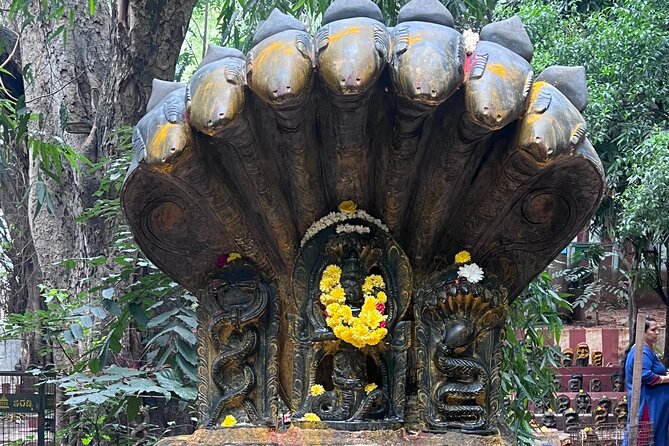
One of the most memorable parts is the Dakshina Mukha Nandi Teertha Kalyani Kshetra, an underground temple with a unique water system. The tour gives you about 15 minutes here, but the place itself is the story—because it’s not just a temple space, it’s a designed water feature integrated into worship.
What makes this stop special is the way it challenges your expectations. In a city full of modern infrastructure, it’s a clear reminder that older Bangalore solved practical problems with architecture. The guide explains the setting and the water connection, so you don’t just see a stairway-down and move on.
Because it’s underground, expect it to feel cooler and more enclosed than street level. Keep your camera ready, but keep your attention on what the guide is pointing out—this is a site where the details are the whole point.
Kadu Malleshwara Temple: Why Malleshwaram is named for faith
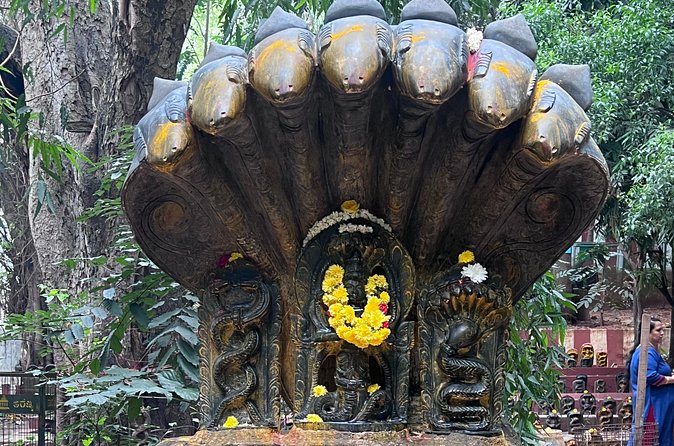
Next you visit the Kadu Malleshwara Temple, a historic Shiva temple tied closely to Malleshwaram’s spiritual identity. You’ll have about 30 minutes here, which is enough time to actually take in the temple space and let the guide’s narrative settle.
This stop works well because it adds depth to everything you’ve been seeing in the neighborhood. Earlier you’re learning how water and settlement shaped the area. Now you’re seeing how worship and community shaped it too. The temple isn’t presented as a distant relic; it’s positioned as central to what the neighborhood has been and still is.
If you’re someone who reads the city through religion, this is a highlight. If you’re less religious, still treat it as cultural architecture—one of the main ways Bengaluru’s neighborhoods express identity.
8th Cross markets: Flowers, vegetables, and everyday commerce
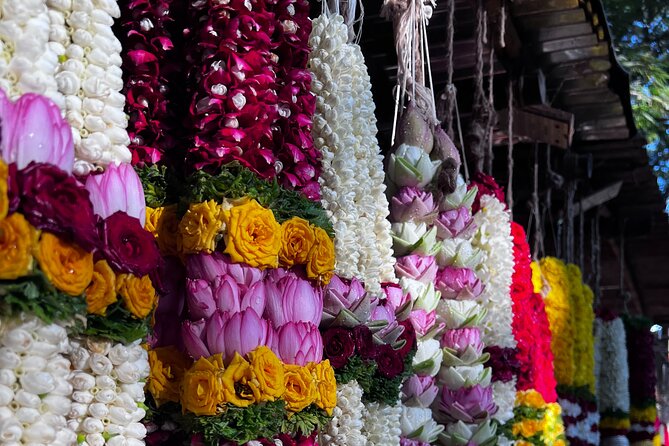
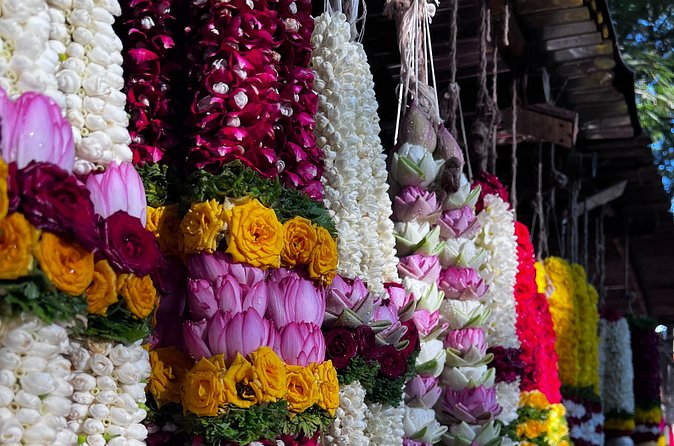
From temples, you move into street-level life at Malleshwaram’s flower and vegetable markets, especially around 8th Cross. This stop lasts about 20 minutes, and it’s exactly the kind of sensory walk moment that makes heritage feel real.
You’ll see fresh produce, vibrant flower stalls, and the chatter of neighborhood commerce. The point isn’t to do a shopping spree. It’s to understand how commerce works here—how a local market supports both rituals and meals, from flowers for worship to vegetables for lunch the same day.
Tip: if you have allergies or strong sensitivities to scents, be aware there are flowers here. If you like color and motion, this stop delivers fast.
You can also read our reviews of more historical tours in Bangalore


Street art in Malleshwaram alleys: Old stories painted back into view
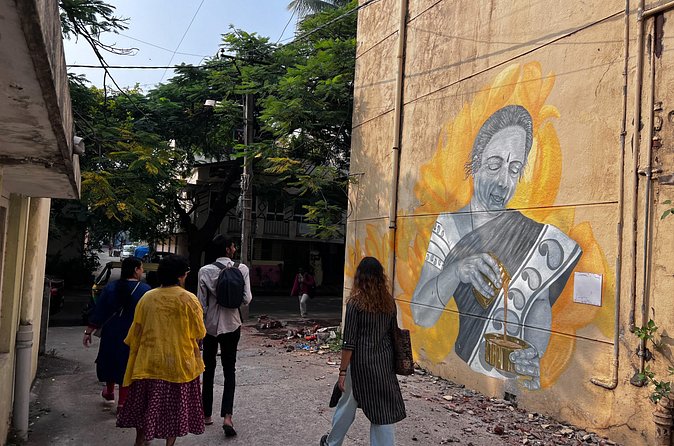
Then comes Malleshwaram Street Art, focused on murals showing old Bengaluru’s heritage and everyday life. You’ll spend around 20 minutes in rejuvenated back alleys.
This part surprised me in the best way. Street art can be random in some cities, but here it’s tied directly to place. The guide’s framing helps you see it as storytelling and memory work—like the neighborhood is handing you short chapters as you walk.
What to look for: figures and daily scenes that reflect old neighborhood routines. Even without reading every detail, you’ll get the sense that the past is being translated into something you can literally walk past.
Veena Stores breakfast: Idlis, vadas, and filter coffee done right
A big chunk of the tour—about 45 minutes—is breakfast at Veena Stores. This is where the tour stops feeling like a sightseeing list and starts feeling like Bangalore life.
You’ll try classic South Indian breakfast items: idlis, vadas, and filter coffee. This is a strong value element because food time is included, not just a quick bite. And breakfast in India isn’t an afterthought; it’s often the main event for the day.
I like that the tour schedules food after the market and street art stops. Your appetite is already awake, and the meal feels earned rather than forced.
Practical advice: eat steadily. Don’t try to rush the coffee and idli/vada portions like you’re on a deadline. This break is part of the experience.
Asha Sweet Center badam milk: A classic Bangalore pause
After breakfast, you make a shorter stop at Asha Sweet Center, where you refresh with badam milk. This lasts about 15 minutes, and the snack-style timing keeps it from dragging.
The reason this works is simple: it’s a local signature drink with strong Bangalore associations. It gives you a quick taste of neighborhood sweetness and culture without turning the morning into a long food marathon.
Also, sweet shops like this often operate on steady routines. Even in a brief stop, you can feel how the place fits into daily life.
Dhobi Ghat: Traditional laundry practices at the end of the walk
The final stop is Dhobi Ghat at Malleshwaram, with the tour concluding near Dhobi Ghat. You’ll have about 15 minutes here.
This is where the walk lands emotionally. You started with calm water and temple worship, and you end with labor and routine—heritage laundry practices alongside modern life. It’s not just a photo stop. It’s a window into how work supports the entire city’s rhythms.
What I’d watch for: the contrast between old methods and today’s pace. The guide’s framing helps you see Dhobi Ghat as living heritage, not a museum display.
Price and logistics: Does $60 make sense for 3 hours?
At $60 per person, this is not a bargain-basement walking tour. But when you look at what’s included, it starts to feel more fair.
You get:
- a guided walk with an English-speaking local,
- entry fees for the sites in the itinerary,
- snacks, breakfast, and beverages as listed,
- and applicable taxes.
So you’re paying for the guide, time, and the food program, not just for the walking. If you’d otherwise spend money on entrance tickets plus breakfast plus a guide for a short morning, this can actually pencil out more reasonably than it first sounds.
Where the price might sting: if you’re traveling with your own private food plans already set, or if you’re skipping most of the included sites (especially the temples). Then you’re paying mostly for guidance and food—so you want to be sure you’ll use both.
One more detail that matters: maximum group size is 14. That usually keeps things manageable and lets the guide answer questions without turning the walk into a shuffle.
Who this walk suits best (and who should skip it)
This is a strong fit if you:
- like temples, old neighborhoods, and the stories that explain everyday life,
- enjoy local food, especially South Indian breakfast,
- want a morning activity that stays focused and efficient,
- and appreciate a guide who can connect history to what you’re seeing right now (Sneha gets named in the positive feedback for exactly this).
It may be less ideal if you:
- dislike early starts (it begins at 7:00 am),
- prefer to keep religion out of your sightseeing,
- or want transport handled end to end (transport is not included).
If you’re comfortable walking around Malleshwaram for about 3 hours, you’re in good shape.
Should you book the Bygone Bengaluru Malleshwaram Heritage Walk?
I’d book it if you want a guided morning that blends heritage and real neighborhood routine, with food stops that actually feel like part of the culture. The strongest reasons are the temple sequence (including the underground site with the water system), plus the local breakfast and the ending at Dhobi Ghat. This is the kind of tour that helps you understand how Malleshwaram works, not just what it looks like.
FAQ
How long is the Malleshwaram Heritage Walk?
The walk is about 3 hours.
What time does the tour start?
It starts at 7:00 am.
Where do I meet the guide?
Meet at Sankey Tank, Kodandarampura, Malleshwaram, Bengaluru, Karnataka 560080. The tour ends at Dhobi Ghat, MalleshwaraU13/1, 6th Temple St, Vyalikaval, Kodandarampura, Malleshwaram, Bengaluru.
What’s the maximum group size?
The experience has a maximum of 14 travelers.
What’s included in the price?
It includes a guided walk with an English-speaking local guide, entry fees to the sites on the itinerary, snacks and breakfast/beverages as listed, and applicable taxes.
Is bottled water or transportation included?
No. bottled water and transportation are not included.
What happens if weather is bad?
This experience requires good weather. If it’s canceled due to poor weather, you’ll be offered a different date or a full refund.